Thesis / Deep Dive
Neural vs. Analog
Night Vision
For decades, seeing in the dark meant accepting green phosphor, high voltage, and hardware that hasn't changed since the 1960s. Here's why digital night vision — built on deep learning — is rendering the image intensifier tube obsolete.
The image intensifier tube.
A Cold War relic still strapped to helmets today.
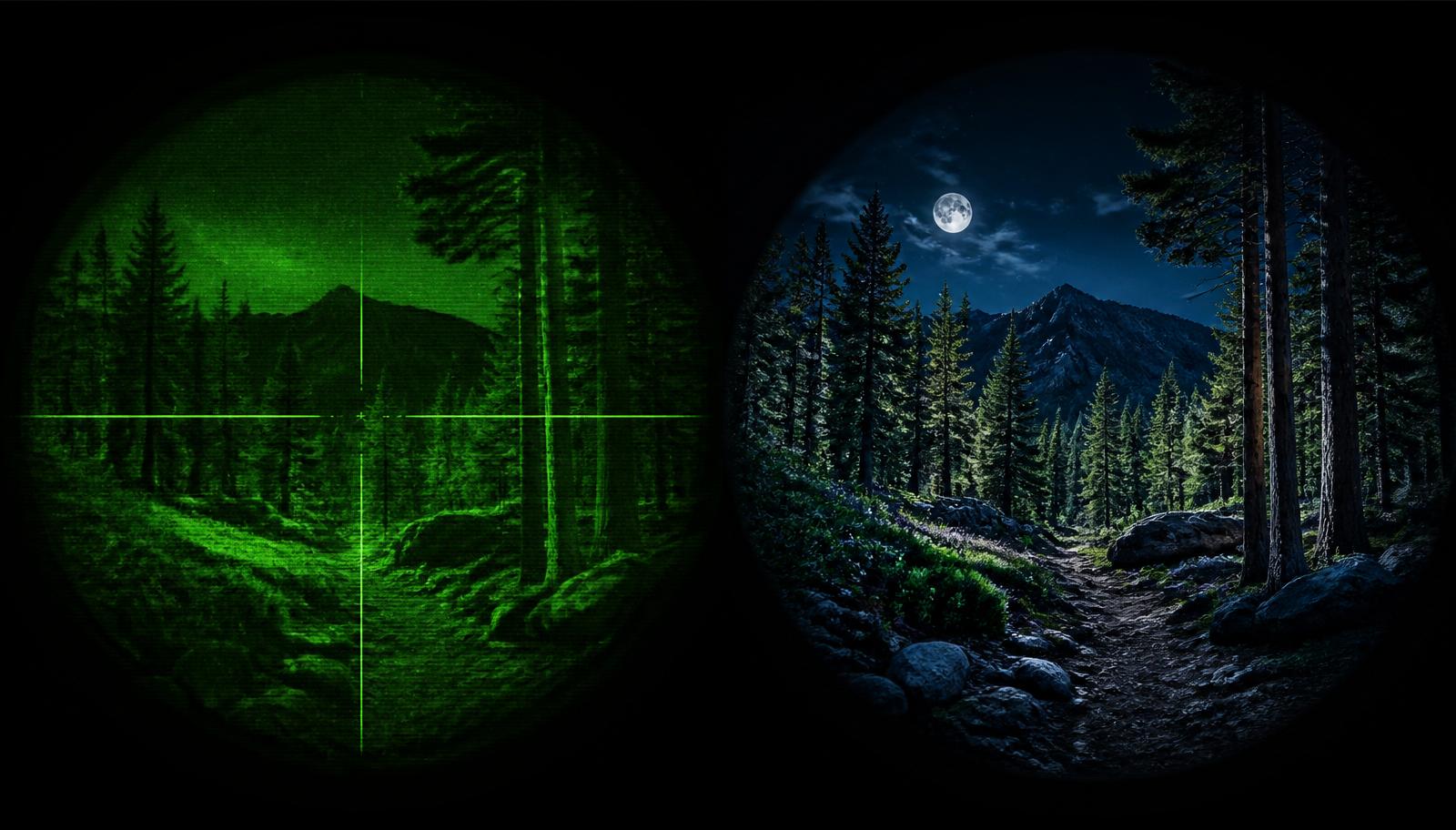
Analog night vision works by collecting ambient photons through an objective lens, converting them to electrons via a photocathode, amplifying them through a microchannel plate, and slamming them into a phosphor screen. The result is the iconic green glow — P-43 phosphor — chosen because the human eye is most sensitive to green in low light.
The technology is remarkable for its era, but it is fundamentally a brute-force amplifier. It cannot reconstruct color, struggles with dynamic range, blooms in high-contrast scenes, and requires thousands of volts to operate. The tube itself is fragile — a knock can destroy a $4,000 component.
Monochrome green output. No color information is preserved.
3,000–5,000V required for electron multiplication.
Microchannel plates crack under shock or rapid G-forces.
The deep learning sensor.
Inference replaces amplification.
Neural night vision treats sight as a reconstruction problem. A CMOS sensor counts individual photons across visible and near-infrared spectra. A deep learning model — trained on millions of paired dark-and-light scenes — infers what the world looks like from those sparse photons. The result is full-color, high-fidelity vision at light levels where the human eye sees nothing.
Because the system is computational, not analog, it improves with every training batch. New scenes, new edge cases, and new sensor data continuously refine the model. There is no phosphor, no high voltage, no tube to break. Just a sensor, a chip, and a model that knows what the world looks like.
RGB reconstruction from photon-starved input. No green tint.
Entire module draws under 6W — no high-voltage supply needed.
No vacuum tube. No microchannel plate. Shock and vibration proof.
Head to Head
Digital vs analog night vision.
The specs don't lie.
| Metric | Analog (I² Tube) | Neural (Deep Learning) |
|---|---|---|
| Color output | Monochrome green (P-43 phosphor) | Full RGB reconstruction |
| Minimum light | ~0.001 lux (Gen 3) | 0.0005 lux |
| Power draw | ~2–4W (tube only; 8–12W with optics) | 5.8W total module |
| Latency | ~1–2 ms (photon-to-phosphor) | 11 ms end-to-end |
| Dynamic range | Poor — blooms in high contrast | Wide — HDR reconstruction |
| Durability | Fragile tube; sensitive to light overload | Solid state; no overload risk |
| Form factor | Goggle-mounted; heavy | 28 g camera module; USB-C |
| Cost trajectory | Flat; limited by vacuum manufacturing | Falling; follows silicon + ML curves |
| Upgrade path | None — hardware locked | Over-the-air model updates |
The green tube had a good run.
Deep learning is what comes next.
Analog night vision defined a generation of military, law-enforcement, and civilian capability. But it is a hardware technology trapped by physics: vacuum tubes, high voltage, and phosphor screens don't get better with software updates. Digital night vision — built on deep learning — does.
At Tarsir Vision, we are building the sensor that replaces the tube. Not a better goggle, but a fundamentally different approach to seeing in the dark: inference over amplification, color over green, silicon over glass. If you're evaluating next- generation night vision for defense, robotics, or automotive, we'd like to talk.